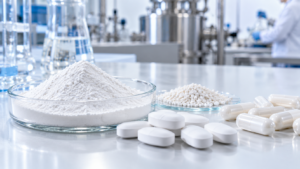
Key Properties of Sodium bicarbonate
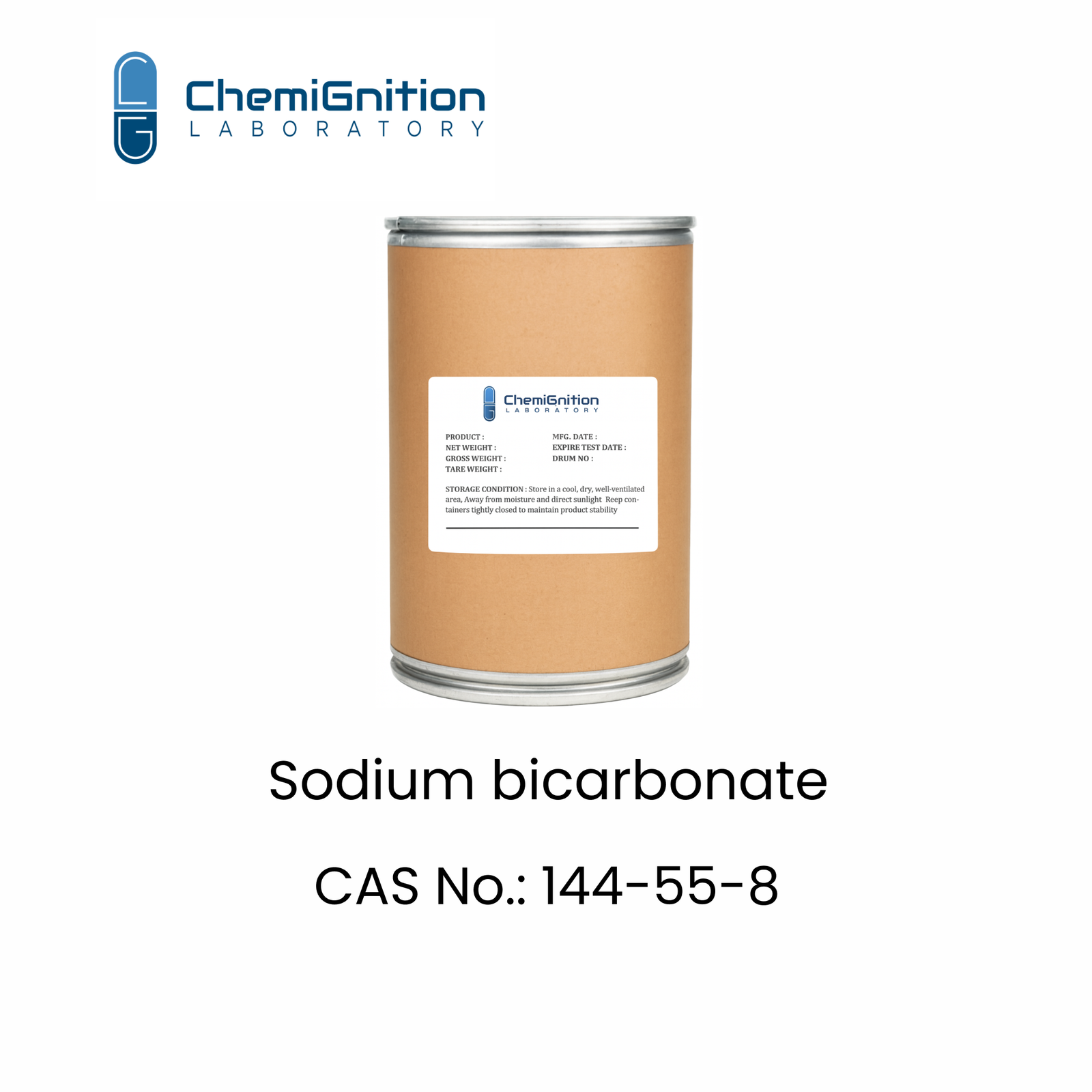
| Product Name: | Sodium Bicarbonate |
| Synonyms: | Sodium Hydrogen Carbonate, Baking Soda |
| CAS No: | 144-55-8 |
| Chemical Formula: | NaHCO₃ |
| Grade: | IP / BP / USP |
| Appearance: | White or almost white, crystalline powder |
| Molar Mass: | 84.01 g/mol |
| Solubility: | Soluble in water, practically insoluble in ethanol |
| pH: | Not more than 8.6 |
 Inquiry
 Whatsapp
Sodium bicarbonate Manufacturing process
Sodium Bicarbonate (NaHCO₃) is commonly manufactured by carbonation of a sodium carbonate solution. Purified sodium carbonate is dissolved in purified water to prepare a controlled-concentration solution. Carbon dioxide gas is introduced into the solution under controlled temperature and pH conditions, resulting in the formation and crystallisation of Sodium Bicarbonate.
Na₂CO₃ + CO₂ + H₂O → 2 NaHCO₃
The Sodium Bicarbonate crystals are then separated by filtration or centrifugation, washed to remove soluble impurities, and carefully dried at a controlled temperature to minimise decomposition. The dried material is subsequently sieved or milled to achieve the required particle size and packed under suitable conditions.
For pharmaceutical or food-grade Sodium Bicarbonate, the raw materials, purified water, processing conditions and finished product are controlled and tested according to the applicable pharmacopoeial or food-grade specification.
Sodium bicarbonate Applications
Pharmaceutical Applications
Antacid Formulations
Buffering & pH Adjustment
Effervescent Formulations
Dialysis Applications
Pharmaceutical Excipient
Cosmetic & Personal Care Applications
Oral Care Products
Deodorant Formulations
Bath & Cleansing Products
Food Applications
Bakery & Leavening
Acidity Regulation
Baking Powder & Premixes
Processed Foods
Industrial Applications
Water Treatment
Flue Gas Treatment
Detergents & Cleaning
Chemical Processing
Fire Extinguishing Powders
Sodium bicarbonate Specifications
Sodium Bicarbonate IP Specification
 Download Sodium Bicarbonate IP Specification
| Sr. No. | Test | Specification |
|---|---|---|
| 1 | Description | A white, crystalline powder or small, opaque, monoclinic crystals. |
| 2 | Identification A | A pale pink colour is produced. On heating, a gas is evolved and the solution becomes red. |
| 3 | Identification – Bicarbonates | Gives reaction (A) of bicarbonates. |
| 4 | Identification – Sodium | Gives the reactions of sodium salts. |
| 5 | Appearance of Solution | Solution is clear and colourless. |
| 6 | Arsenic | Not more than 2 ppm. |
| 7 | Calcium | A 2.0% w/v solution, when boiled for 5 minutes, is clear. |
| 8 | Heavy Metals | Not more than 5 ppm. |
| 9 | Iron | Not more than 20 ppm. |
| 10 | Carbonate (pH) | pH of freshly prepared Solution A: Not more than 8.6. |
| 11 | Chlorides | Not more than 200 ppm. |
| 12 | Sulphates | Not more than 150 ppm. |
| 13 | Assay (NaHCO₃) | Not less than 99.0% to Not more than 101.0%. |
Sodium Bicarbonate USP Specification
Download Sodium Bicarbonate USP Specification
| Sr. No. | Test | Specification |
|---|---|---|
| 1 | Identification – Sodium | Meets the requirements. |
| 2 | Identification – Bicarbonate | Meets the requirements. |
| 3 | Assay (NaHCO₃) | Not less than 99.0% to Not more than 100.5% on the dried basis. |
| 4 | Insoluble Substances | The resulting solution is complete and clear. |
| 5 | Carbonate | Not more than 0.23%. |
| 6 | Normal Carbonate | The solution does not assume more than a faint pink colour immediately. |
| 7 | Chloride and Sulfate – Chloride | Not more than 0.015%. |
| 8 | Limit of Sulfur Compounds | Not more than 0.01%. |
| 9 | Arsenic | Not more than 2 ppm. |
| 10 | Calcium* | Not more than 0.01%. |
| 11 | Magnesium* | Not more than 0.004%. |
| 12 | Copper* | Not more than 1 ppm. |
| 13 | Iron* | Sample absorbance is not more than that of the Standard solution (NMT 5 ppm). |
| 14 | Limit of Ammonia | Not more than 20 ppm. |
| 15 | Limit of Organics* | Not more than 0.01%. |
| 16 | Loss on Drying | Not more than 0.25%. |
Sodium Bicarbonate BP Specification
Download Sodium Bicarbonate BP Specification
| Sr. No. | Test | Specification |
|---|---|---|
| 1 | Description | White or almost white, crystalline powder. |
| 2 | Solubility | Soluble in water, practically insoluble in ethanol (96 per cent). |
| 3 | Identification A | A pale pink colour is produced; on heating, gas is evolved and the solution becomes red. |
| 4 | Identification – Carbonates and Bicarbonates | Gives the reaction of carbonates and bicarbonates. |
| 5 | Identification – Sodium | Gives reaction of sodium. |
| 6 | Appearance of Solution | Solution is clear and colorless. |
| 7 | pH | Not more than 8.6. |
| 8 | Chlorides | Not more than 150 ppm. |
| 9 | Sulfates | Not more than 150 ppm. |
| 10 | Ammonium | Not more than 20 ppm. |
| 11 | Calcium | Not more than 100 ppm. |
| 12 | Iron | Not more than 20 ppm. |
| 13 | Assay (NaHCO₃) | Not less than 99.0% to Not more than 101.0%. |
Sodium bicarbonate Packing and Storage condition
Packaging:
Sodium Bicarbonate is packed in 25 kg HDPE bags/drum with an inner polyethylene liner or as per customer requirements. Suitable export-grade packaging can be provided to protect the material from moisture and contamination during transportation and storage.
Storage:
Store Sodium Bicarbonate in a cool, dry and well-ventilated place in tightly closed containers. Protect from moisture, excessive heat and incompatible acidic materials. Keep the packaging properly sealed when not in use to maintain product quality and prevent contamination.
Why Choose Chemignition for
Sodium bicarbonate Supply?
Quality Assurance
Grade Compliance
Sodium bicarbonate is manufactured in adherence to stringent global pharmaceutical standards.
In-House Quality Control
Each batch undergoes rigorous testing for purity, stability, and efficacy.
Regulatory Approvals
Certified for export and compliant with international regulatory requirements.
Large-Scale Manufacturing and Export
Grade Compliance
Sodium bicarbonate is manufactured in adherence to stringent global pharmaceutical standards.
In-House Quality Control
Each batch undergoes rigorous testing for purity, stability, and efficacy.
Regulatory Approvals
Certified for export and compliant with international regulatory requirements.