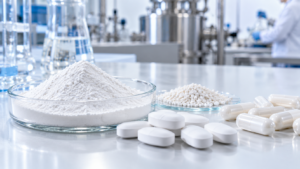
Key Properties of Sodium Acetate
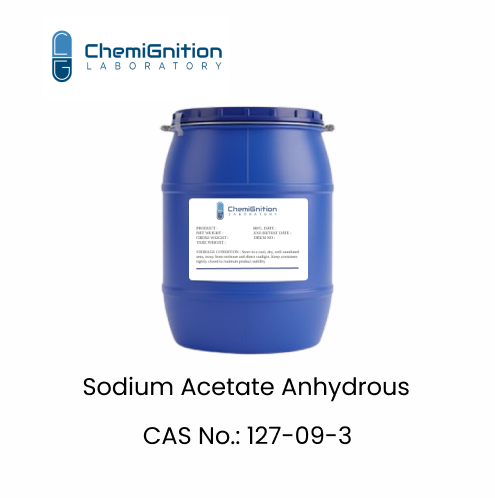
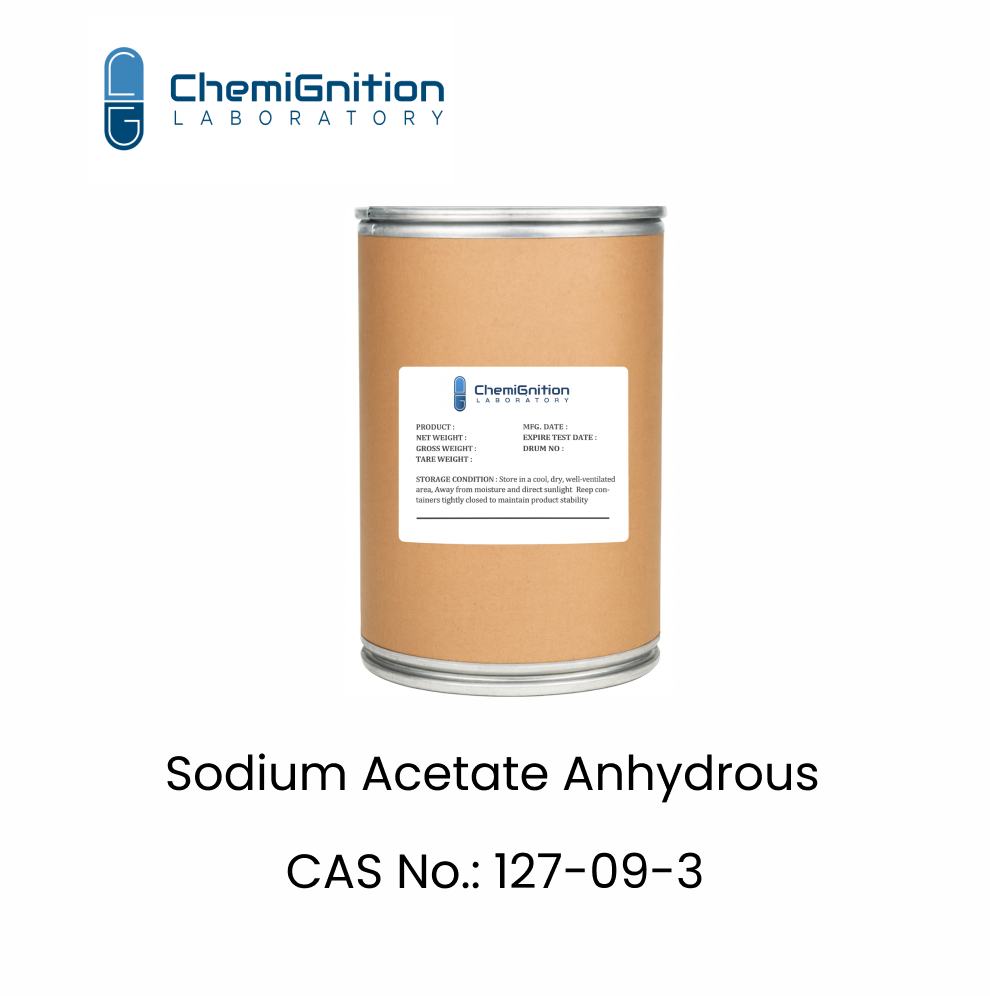
| Product Name: | Sodium Acetate |
| Available form: | 1. Sodium Acetate Anhydrous 2. Sodium Acetate Trihydrate |
| CAS No: | 127-09-3 and 6131-90-4 |
| Chemical Formula: | C₂H₃NaO₂ and C₂H₃NaO₂ ⋅ 3H₂O |
| Grade: | USP and IP / BP / USP |
| Available Pack size: | 25 kg, 50 kg, 100 kg, or customized |
| Available Documents: | COA, MSDS and TDS |
| Self life: | 5 Year |
 Inquiry
 Whatsapp
Sodium Acetate Manufacturing process
1. Reaction (Neutralization Process)
Acetic acid is taken in a reaction vessel, and sodium carbonate or sodium hydroxide is gradually added under controlled stirring.
The temperature is maintained between 50°C to 70°C to ensure complete neutralization.
The process continues until a clear sodium acetate solution is formed.
2. Filtration (Impurity Removal)
The sodium acetate solution is passed through a vacuum filter or centrifuge to remove insoluble impurities.
3. Evaporation (Concentration Process)
The filtered solution is heated in an evaporator at 80°C to 90°C under reduced pressure.
This step removes excess water, resulting in a highly concentrated sodium acetate solution.
4. Crystallization (Formation of Sodium Acetate Trihydrate)
The concentrated solution is cooled to 10°C to 20°C, leading to the crystallization of Sodium Acetate Trihydrate.
The crystals are collected using a centrifuge or vacuum filtration.
5. Dehydration (Conversion to Anhydrous Form)
The Sodium Acetate Trihydrate crystals are transferred to a drying oven or fluid bed dryer.
Heated at 120°C to 150°C under vacuum or dry air circulation to remove water molecules.
This results in the formation of Sodium Acetate Anhydrous.
6. Grinding & Sieving
The dried Sodium Acetate Anhydrous is milled and passed through a vibro sifter to achieve the desired particle size.
7. Final Packaging & Storage
The final Sodium Acetate Anhydrous powder is packed in moisture-proof HDPE bags or drums.
Stored in a cool, dry place to prevent moisture absorption.
Sodium Acetate Applications
Pharmaceutical Applications
Buffering Agent in Pharmaceutical Formulations
Parenteral and Dialysis Formulations
Pharmaceutical Processing
Food Applications
Acidity Regulator and Buffer
Preservative Applications
Flavouring and Seasoning
Chemical and Industrial Applications
Buffer Preparation and pH Control
Chemical Synthesis
Textile Processing
Dyes, Pigments and Specialty Chemicals
Laboratory Applications
Reagents
Sodium Acetate Specifications
Sodium Acetate Anhydrous USP Specification
 Download Sodium Acetate Anhydrous USP Specification
| Sr. No. | Test | Specification |
|---|---|---|
| 1 | Description | White or almost white, crystalline powder or colourless crystals. |
| 2 | Solubility | Freely soluble in water, practically insoluble in ethanol (96 per cent) |
| 3 | Identification by Sodium | It gives reaction of Sodium. |
| 4 | Identification by Acetate | It gives reaction of Acetate. |
| 5 | Chloride | Not more than 350 ppm |
| 6 | Sulphate | Not more than 50 ppm |
| 7 | Calcium and Magnesium | Passes test |
| 8 | Potassium | Passes test |
| 9 | Aluminium* | Not more than 0.2 ppm (“*” Aluminium test applicable only when Sodium Acetate is intended for use in the preparation of dialysis solutions) |
| 10 | pH | 7.5 to 9.2 |
| 11 | Insoluble matter | Not more than 0.05% |
| 12 | Loss on drying | Not more than 1.0% |
| 13 | Assay (On dried basis) | Not less than 99.00% and not more than 101.00% |
Sodium Acetate Trihydrate IP Specification
Download Sodium Acetate Trihydrate IP Specification
| Sr. No. | Test | Specification |
|---|---|---|
| 1 | Description | Colourless crystals or a white, crystalline powder. |
| 2 | Solubility | Freely soluble in water, practically insoluble in ethanol (96 per cent) |
| 3 | Identification by Sodium | It gives reaction of Sodium. |
| 4 | Identification by Acetate | It gives reaction of Acetate. |
| 5 | Appearance of solution | Solution is clear and colourless |
| 6 | pH | 7.5 to 9.0 |
| 7 | Arsenic | Not more than 2 ppm |
| 8 | Calcium and Magnesium | Not more than 50 ppm, calculated as Ca |
| 9 | Heavy Metals | Not more than 10 ppm |
| 10 | Iron | Not more than 20 ppm |
| 11 | Chlorides | Not more than 250 ppm |
| 12 | Sulphates | Not more than 200 ppm |
| 13 | Aluminium* | Not more than 0.2 ppm (“*” Aluminium test applicable only when Sodium Acetate is intended for use in the preparation of dialysis solutions) |
| 14 | Reducing Substances | Passes the test |
| 15 | Loss on Drying | 39.0% to 40.5% |
| 16 | Assay (On dried basis) | Not less than 99.00% to not more than 101.0% |
Sodium Acetate Trihydrate BP Specification
Download Sodium Acetate Trihydrate BP Specification
| Sr. No. | Test | Specification |
|---|---|---|
| 1 | Description | White or almost white, crystalline powder or colourless crystals. |
| 2 | Solubility | Very soluble in water; soluble in ethanol (96 per cent). |
| 3 | Identification by Sodium | It gives reaction of Sodium. |
| 4 | Identification by Acetate | It gives reaction of Acetate. |
| 5 | Appearance of solution | Solution is clear and colourless |
| 6 | pH | 7.5 to 9.0 |
| 7 | Reducing Substances | Passes the test |
| 8 | Chlorides | Not more than 200 ppm |
| 9 | Sulphates | Not more than 200 ppm |
| 10 | Aluminium* | Not more than 0.2 ppm (“*” Aluminium test applicable only when Sodium Acetate is intended for use in the preparation of dialysis solutions) |
| 11 | Calcium and Magnesium | Not more than 50 ppm, calculated as Ca |
| 12 | Iron | Not more than 10 ppm |
| 13 | Loss on Drying | 39.0% to 40.5% |
| 14 | Assay (on dried substance) | Not less than 99.00% to not more than 101.00% |
Sodium Acetate Trihydrate USP Specification
Download Sodium Acetate Trihydrate USP Specification
| Sr. No. | Test | Specification |
|---|---|---|
| 1 | Description | White or almost white, crystalline powder or colourless crystals. |
| 2 | Solubility | Freely soluble in water, practically insoluble in ethanol (96 per cent) |
| 3 | Identification by Sodium | It gives reaction of Sodium. |
| 4 | Identification by Acetate | It gives reaction of Acetate. |
| 5 | Chloride | Not more than 350 ppm |
| 6 | Sulphate | Not more than 50 ppm |
| 7 | Calcium and Magnesium | Passes test |
| 8 | Potassium | Passes test |
| 9 | Aluminium* | Not more than 0.2 ppm (“*” Aluminium test applicable only when Sodium Acetate is intended for use in the preparation of dialysis solutions) |
| 10 | pH | 7.5 to 9.2 |
| 11 | Insoluble matter | Not more than 0.05% |
| 12 | Loss on drying | 38.0% to 41.0%. |
| 13 | Assay (On dried basis) | Not less than 99.00% and not more than 101.00% |
Sodium Acetate Packing and Storage condition
Packing:
Packed in 25 kg / 50 kg HDPE bags with inner liner.
Available in fiber drums or customized packaging as per customer requirements.
Tamper-proof and moisture-resistant packaging ensures product stability.
Storage:
Store in a cool, dry, and well-ventilated area away from moisture.
Keep the container tightly closed to prevent contamination.
Avoid exposure to direct sunlight and incompatible materials (such as strong acids).
Recommended storage temperature: Below 30°C.
Why Choose Chemignition for
Sodium Acetate Supply?
Quality Assurance
Grade Compliance
Sodium Acetate is manufactured in adherence to stringent global pharmaceutical standards.
In-House Quality Control
Each batch undergoes rigorous testing for purity, stability, and efficacy.
Regulatory Approvals
Certified for export and compliant with international regulatory requirements.
Large-Scale Manufacturing and Export
Grade Compliance
Sodium Acetate is manufactured in adherence to stringent global pharmaceutical standards.
In-House Quality Control
Each batch undergoes rigorous testing for purity, stability, and efficacy.
Regulatory Approvals
Certified for export and compliant with international regulatory requirements.