
Dipotassium Hydrogen Phosphate, commonly known as Dipotassium Phosphate or Dibasic Potassium Phosphate, is an inorganic phosphate salt widely used across pharmaceutical, food, laboratory, and industrial sectors. Its excellent water solubility, buffering capacity, and chemical stability make it suitable for applications where consistent pH control and reliable performance are required.
This article explains the chemical properties of Dipotassium Hydrogen Phosphate and highlights its major industrial applications.
What is Dipotassium Hydrogen Phosphate?
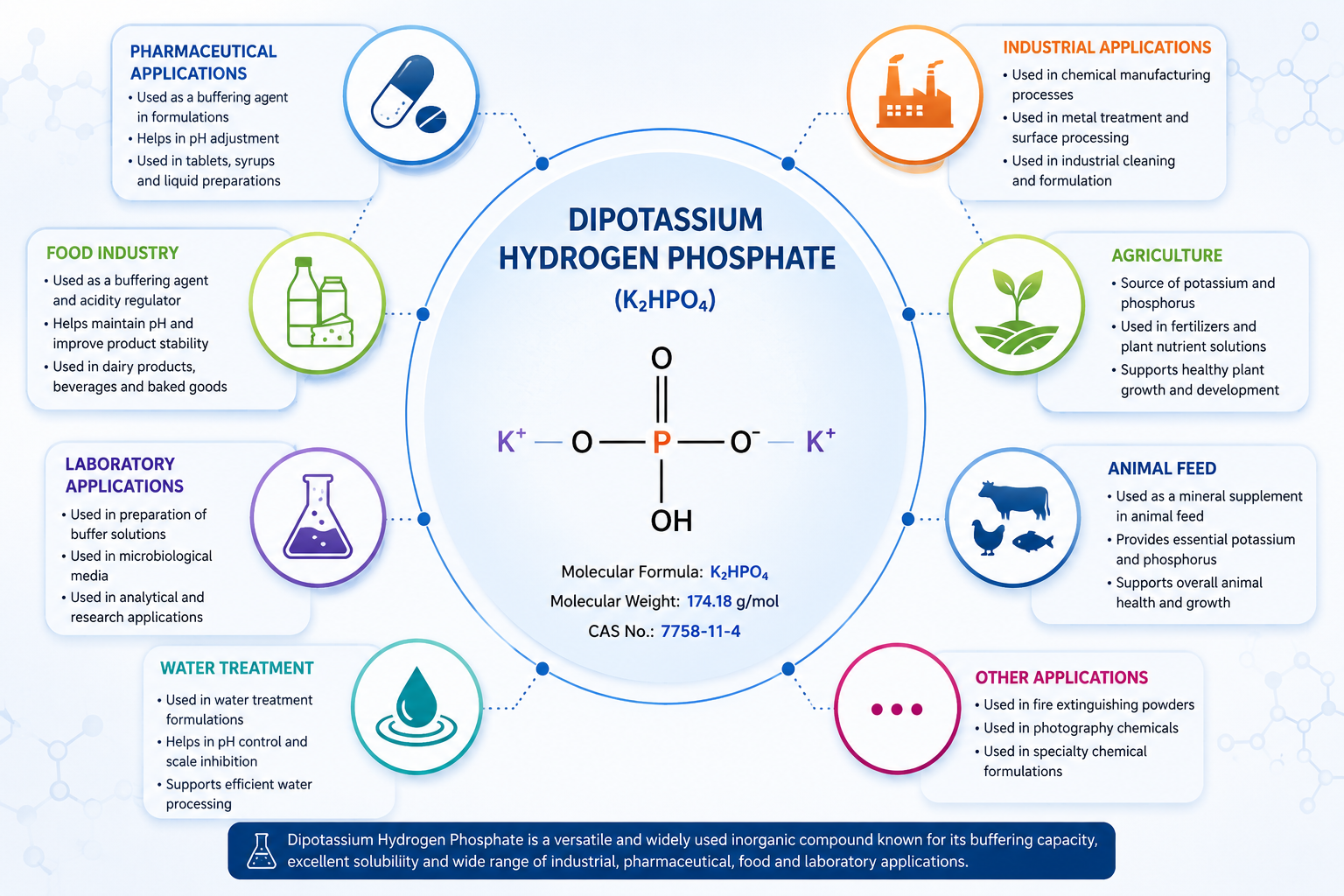
It is the potassium salt of phosphoric acid with the chemical formula K₂HPO₄. It appears as a white crystalline powder or granules and dissolves readily in water, producing a mildly alkaline solution.
Manufacturers use Dipotassium Hydrogen Phosphate to provide potassium and phosphate ions while maintaining stable pH conditions in pharmaceutical, food, laboratory, and industrial applications.
Chemical Properties of Dipotassium Hydrogen Phosphate
| Chemical Formula | K₂HPO₄ |
| Molecular Weight | 174.18 g/mol |
| CAS Number | 7758-11-4 |
| Appearance | White crystalline powder or granules. |
| Solubility | Highly soluble in water. |
| Stability | Stable under recommended storage conditions when protected from moisture. |
| Buffering Capacity | One of its most important characteristics is its ability to maintain stable pH values in aqueous systems. |
Industrial Uses of Dipotassium Hydrogen Phosphate
Pharmaceutical Industry
In pharmaceutical manufacturing, Dipotassium Hydrogen Phosphate is commonly used as:
- Buffering agent
- pH adjuster
- Electrolyte source
- Laboratory reagent
- Formulation ingredient
Its buffering properties help maintain product stability during manufacturing and storage.
Food Industry
Food-grade Dipotassium Hydrogen Phosphate is used in various food applications as a:
- Buffering agent
- Mineral source
- Stabilizer
- Acidity regulator
Its functionality helps improve formulation consistency while supplying potassium and phosphorus.
Laboratory Applications
Laboratories use Dipotassium Phosphate for:
- Buffer preparation
- Analytical testing
- Microbiological media
- Research applications
- Calibration solutions
Specialty Chemical Industry
The specialty chemical industry uses Dipotassium Phosphate for:
- Chemical processing
- Water treatment formulations
- Industrial cleaning products
- Process chemistry
- Specialty formulations
Advantages of Dipotassium Hydrogen Phosphate
Some of the key advantages include:
- Excellent water solubility
- Effective pH buffering
- Good chemical stability
- Consistent performance
- Wide industrial applicability
- Easy handling and storage
Storage Recommendations
For optimum product quality, Dipotassium Phosphate should be stored:
- In tightly closed containers
- In a cool and dry place
- Away from direct moisture
- Protected from contamination
Following these practices helps maintain the product’s physical and chemical properties during storage.
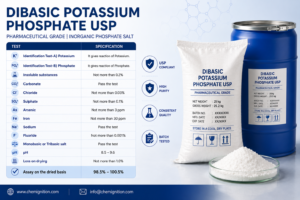
Quality Documentation
Depending on customer requirements, technical documentation may include:
- Certificate of Analysis (COA)
- Material Safety Data Sheet (MSDS)
- Technical Data Sheet (TDS)
- Product Specification
These documents assist customers during product qualification and regulatory review.
Conclusion
Dipotassium Phosphate is an important inorganic phosphate compound valued for its buffering capacity, water solubility, and chemical stability. These properties make it suitable for a wide range of pharmaceutical, food, laboratory, and specialty chemical applications. Selecting a reliable supplier with established quality systems and comprehensive technical documentation helps ensure consistent product quality and dependable supply.
About Chemignition Laboratory
Chemignition Laboratory is a manufacturer, supplier, and exporter of pharmaceutical ingredients, excipients, and specialty chemicals. We support customers with consistent product quality, comprehensive technical documentation, and reliable global supply.
Our product portfolio includes phosphate salts, citrate salts, acetate salts, laboratory chemicals, and specialty chemicals for pharmaceutical and industrial applications.
Explore our Dipotassium Phosphate product page to learn more about product specifications, documentation, and available packaging options.
Refer www.chemignition.com
FAQs
What is Dipotassium Hydrogen Phosphate used for?
It is commonly used as a buffering agent, pH adjuster, electrolyte source, laboratory reagent, and formulation ingredient in pharmaceutical, food, laboratory, and industrial applications.
Is Dipotassium Hydrogen Phosphate soluble in water?
Yes. It is highly soluble in water, making it suitable for aqueous formulations and buffer systems.
What is another name for Dipotassium Hydrogen Phosphate?
It is also known as Dipotassium Phosphate, Dibasic Potassium Phosphate, and Potassium Phosphate Dibasic.
What technical documents are generally available?
Manufacturers typically provide documents such as COA, MSDS, TDS, and product specifications, depending on customer requirements.