

Sampling in the pharmaceutical industry is an important quality-control activity used to obtain representative samples of materials for examination or testing. Pharmaceutical manufacturers use appropriate sampling procedures for raw materials, in-process materials, packaging materials, finished products and other relevant materials according to established procedures.
A well-designed pharmaceutical sampling programme helps generate representative samples, supports reliable testing and reduces the risk of contamination, mix-ups and sampling errors.
What Is Sampling in the Pharmaceutical Industry?
Sampling is the process of collecting a representative portion of a material, batch or lot for examination or laboratory testing. Instead of testing the entire quantity, trained personnel collect samples according to an approved sampling plan and standard operating procedure (SOP).
Pharmaceutical manufacturers use sampling as part of their quality systems to evaluate whether materials and products comply with established specifications and applicable requirements.
An appropriate sampling process helps support:
- Representative laboratory testing
- Material identification and quality evaluation
- Batch-to-batch consistency
- Detection of potential quality issues
- Traceability of collected samples
- Compliance with approved procedures and applicable GMP requirements
Sampling procedures can vary according to the material, batch size, number of containers, manufacturing stage, intended testing and applicable regulatory requirements.
Types of Sampling in the Pharmaceutical Industry
Pharmaceutical manufacturers perform different types of sampling depending on the manufacturing stage, material characteristics and purpose of testing.
1. Raw Material Sampling
Raw material sampling in the pharmaceutical industry involves collecting representative samples from incoming materials such as active pharmaceutical ingredients (APIs), excipients and other materials used in pharmaceutical manufacturing.
Quality-control personnel may test the collected samples according to established specifications before approving or rejecting the material for use.
2. In-Process Sampling
Manufacturers perform in-process sampling at defined stages during pharmaceutical production.
These samples help monitor relevant process parameters or quality attributes and allow manufacturing and quality teams to identify potential deviations during processing.
3. Finished Product Sampling
Finished product sampling involves collecting representative samples after the relevant manufacturing or packaging stages.
Quality-control laboratories test these samples against established finished-product specifications before disposition according to the manufacturer’s quality system.
4. Packaging Material Sampling
Packaging material sampling involves collecting representative samples of materials such as containers, closures, labels and other packaging components.
Manufacturers may examine or test these materials according to approved specifications before use.
5. Stability Sampling
Stability programmes use appropriately selected samples to evaluate product quality over defined storage periods and conditions.
The resulting stability data help establish or support appropriate storage conditions, retest periods or shelf life, as applicable.
6. Environmental Sampling
Pharmaceutical facilities may use environmental monitoring programmes to assess manufacturing environments where appropriate.
Depending on the facility and operation, monitoring may include air, surfaces, personnel or other relevant environmental parameters.
Explore a leading manufacturer of APIs.
With over 10 years of expertise, we ensure GMP compliance and provide reliable, high-quality solutions.
Sampling Tools Used in the Pharmaceutical Industry
Selecting appropriate pharmaceutical sampling tools is important because the equipment should be suitable for the physical characteristics of the material and the intended sampling procedure.
Different tools may be required for powders, granules, liquids and other materials.
| Sampling tool | Typical application |
|---|---|
| Sampling Scoop or Spatula | Collecting accessible samples of powders or granules |
| Sampling Thief | Obtaining powder or granular samples from selected locations or depths |
| Sampling Spear | Sampling powders and granulated materials from suitable containers |
| Liquid Sampler | Collecting representative samples of liquids |
| Pipette or Dipper | Collecting suitable liquid samples |
| Sterile Sampling Container | Collecting samples where microbiological control or sterility is relevant |
| Swab | Surface sampling and suitable cleaning/environmental monitoring applications |
| Air Sampler | Environmental monitoring where airborne particle or microbiological sampling is required |
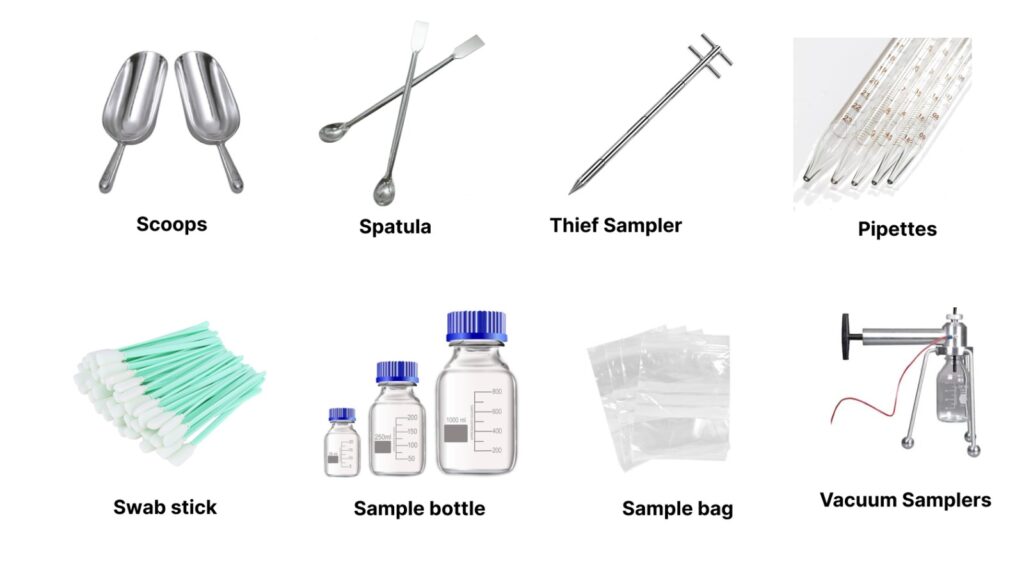
Sampling equipment should be appropriately designed, clean and suitable for its intended use according to the applicable procedure.
Sampling Tools for Powders and Granules
Manufacturers may use scoops, spatulas, sampling thieves or sampling spears for powders and granulated materials.
The appropriate tool depends on factors such as container design, material characteristics, sampling location and sampling plan.
Sampling Tools for Liquids
Liquid sampling may involve suitable pipettes, dippers, liquid samplers or other equipment designed for collecting representative liquid samples.
Personnel should select equipment that is compatible with the material and minimises the potential for contamination.
Selection of Pharmaceutical Sampling Equipment
When selecting sample collection equipment, manufacturers should consider:
- Physical state of the material
- Container type and size
- Sampling location
- Required sample quantity
- Risk of contamination or cross-contamination
- Material compatibility
- Cleaning requirements
- Microbiological requirements, where applicable
- Approved SOP and sampling plan
Raw Material Sampling in the Pharmaceutical Industry
Raw material sampling is an important part of pharmaceutical material control. The objective is to obtain samples suitable for the required examination or testing while maintaining material integrity and traceability.
The sampling approach should account for factors such as the nature of the material, number of containers, supplier status, intended tests and applicable quality procedures.
Raw Material Sampling Procedure
A typical raw material sampling procedure may include the following stages:
- Material receipt and status verification – Verify the material name, supplier information, batch or lot number, container condition and relevant documentation.
- Review of sampling requirements – Follow the approved sampling plan and SOP applicable to the material.
- Preparation of sampling equipment – Select suitable, clean sampling tools and appropriate sample containers.
- Container selection – Identify the containers to be sampled according to the approved sampling plan.
- Sample collection – Collect the required sample while taking appropriate precautions against contamination and mix-ups.
- Sample identification – Label samples with the required traceability information.
- Transfer to the laboratory – Transfer collected samples under suitable conditions.
- Documentation – Record sampling activities according to the applicable documentation procedure.
The exact procedure should follow the manufacturer’s approved SOPs and applicable GMP and regulatory requirements.
Raw Materials Sampling and Testing
Sampling and testing of raw materials are related but distinct quality activities.
Sampling involves obtaining a representative portion of the material. Testing involves examining or analysing the collected sample against established specifications.
Reliable analytical testing therefore depends partly on appropriate sample collection, identification, handling and storage.
Raw Material Sampling Guidelines
An effective raw material sampling programme should consider:
- Material characteristics and associated risks
- Number and condition of containers
- Appropriate sampling locations
- Prevention of contamination and cross-contamination
- Representative sample collection
- Sample identification and traceability
- Appropriate storage and transportation
- Approved sampling plans and SOPs
- Applicable GMP and regulatory requirements
Process Sampling in Pharmaceutical Manufacturing
Process sampling, also called in-process sampling in appropriate contexts, involves collecting samples during defined stages of pharmaceutical manufacturing.
Manufacturers use in-process samples to monitor relevant process parameters or product attributes and determine whether the manufacturing process remains within established controls.
The exact sampling points, frequency, quantity and tests depend on the manufacturing process, product requirements, approved procedures and quality system.
General Sampling Procedure in Pharmaceuticals
Although sampling procedures differ between materials and operations, a controlled pharmaceutical sampling process commonly includes the following stages.
1. Preparation
Personnel review the approved sampling plan and SOP, prepare the required documentation and select appropriate sampling equipment.
2. Material Identification
Personnel verify relevant information such as the material name, batch or lot number, container identification and sampling status.
3. Sampling Area Preparation
Where required, sampling takes place in a suitable controlled area designed to minimise contamination and cross-contamination risks.
4. Sample Collection
Trained personnel collect the required quantity using an appropriate sampling tool and the approved technique.
5. Sample Labelling
Personnel label the collected sample with the information required by the applicable procedure to maintain identification and traceability.
6. Sample Transfer and Storage
Personnel transfer samples to the appropriate laboratory or storage location under conditions suitable for maintaining sample integrity.
7. Documentation
Personnel document the sampling activity according to the applicable SOP, sampling record or other controlled documentation.
Factors Affecting Pharmaceutical Sampling
Several factors can influence the selection and effectiveness of a pharmaceutical sampling procedure, including:
- Material homogeneity
- Physical state of the material
- Batch or lot size
- Number of containers
- Container configuration
- Sampling location
- Required analytical tests
- Risk of contamination
- Sampling tool design
- Storage requirements
- Material sensitivity
- Approved sampling plan
Manufacturers should evaluate these factors when developing appropriate sampling procedures.
Common Sampling Errors and How to Minimise Them
Sampling errors can affect the representativeness and reliability of a sample.
Common issues include:
- Using an unsuitable sampling tool
- Sampling from inappropriate locations
- Insufficient sample quantity
- Cross-contamination between materials
- Incorrect sample identification
- Poor handling or storage
- Incomplete documentation
- Failure to follow the approved sampling plan
Training, suitable equipment, controlled procedures and accurate documentation help minimise these risks.
Important Considerations for Pharmaceutical Sampling
Pharmaceutical manufacturers should conduct sampling according to approved procedures and applicable quality requirements.
In particular:
- Use sampling plans appropriate to the material and purpose.
- Use suitable and appropriately maintained sampling equipment.
- Prevent contamination and cross-contamination.
- Maintain sample identification and traceability.
- Store and transport samples under suitable conditions.
- Document sampling activities accurately.
- Follow applicable GMP requirements, pharmacopoeial requirements and approved internal procedures.
Avoid stating that one sampling quantity or procedure applies universally. The appropriate approach depends on the material, process, intended testing and applicable requirements.
Conclusion
Sampling in the pharmaceutical industry is an important part of pharmaceutical quality systems. Appropriate sampling procedures help manufacturers obtain representative samples of raw materials, in-process materials, finished products and other relevant materials for examination and testing.
The reliability of sampling depends on several factors, including the sampling plan, equipment, material characteristics, sample handling, traceability and documentation. Therefore, pharmaceutical manufacturers should establish and follow appropriate sampling procedures according to their quality systems and applicable GMP and regulatory requirements.
Chemignition Laboratory manufactures and supplies pharmaceutical ingredients under its applicable quality systems. For information about available pharmaceutical ingredients, product specifications and documentation, visit our pharmaceutical products section.
FAQs
What is sampling in the pharmaceutical industry?
Sampling in the pharmaceutical industry involves collecting a representative portion of a material, batch or lot for examination or testing according to an established sampling plan and procedure.
What are the types of sampling in the pharmaceutical industry?
Common types include raw material sampling, in-process sampling, finished product sampling, packaging material sampling, stability sampling and environmental sampling.
What sampling tools are used in pharmaceuticals?
Common pharmaceutical sampling tools include scoops, spatulas, sampling thieves, sampling spears, liquid samplers, pipettes, dippers, sterile containers, swabs and appropriate environmental sampling equipment.
What is raw material sampling?
Raw material sampling involves collecting representative samples from incoming materials for identification, examination or testing according to approved procedures.
What is a raw material sampling procedure?
A raw material sampling procedure typically covers material verification, sampling-plan review, equipment preparation, container selection, sample collection, labelling, transfer and documentation.
What is process sampling in pharmaceuticals?
Process sampling involves collecting samples at defined manufacturing stages to monitor relevant process parameters or quality attributes according to established procedures.
Why are sampling tools important in pharmaceutical manufacturing?
Appropriate sampling tools help personnel obtain representative samples while minimising contamination, cross-contamination and sampling errors.
What is the difference between sampling and testing?
Sampling involves collecting a representative portion of a material or batch. Testing involves examining or analysing that sample against established specifications.