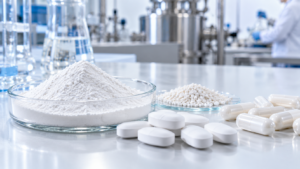
Key Properties of Tartaric Acid
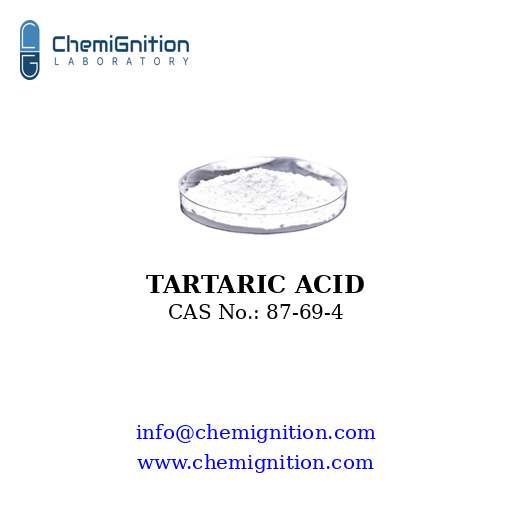
| Product Name: | Tartaric Acid |
| Synonyms: | 2,3-Dihydroxybutanedioic Acid |
| CAS No: | 87-69-4 |
| Chemical Formula: | C₄H₆O₆ |
| Grade: | IP / BP / USP |
| Appearance: | White, crystalline powder |
| Molar Mass: | 150.09 g/mol |
| Solubility: | Soluble in water, slightly soluble in alcohol |
| Melting Point: | 170°C – 172°C |
 Inquiry
 Whatsapp
Tartaric Acid Manufacturing process
Step 1: Raw Material Selection
Source Selection – Tartaric acid is obtained from natural sources like grape residues (wine lees), tamarind, or chemically synthesized.
Quality Check – Raw materials are tested for purity and suitability before processing.
Step 2: Extraction & Conversion
Crude Calcium Tartrate Formation – Wine lees or grape residues are treated with calcium hydroxide (Ca(OH)₂) to form calcium tartrate precipitate.
Filtration – The solid calcium tartrate is separated from the liquid mixture using filtration.
Step 3: Acidification & Tartaric Acid Formation
Treatment with Sulfuric Acid (H₂SO₄) – The filtered calcium tartrate is then treated with sulfuric acid, which releases tartaric acid and forms calcium sulfate (gypsum) as a byproduct.
Separation of Calcium Sulfate – The gypsum is removed via filtration, leaving behind a crude tartaric acid solution.
Step 4: Purification & Concentration
Decolorization – The crude solution is treated with activated carbon to remove impurities and colorants.
Evaporation & Crystallization – The purified solution is concentrated using evaporation, allowing tartaric acid to crystallize.
Cooling & Filtration – The solution is cooled to promote crystal formation, and the crystals are filtered out.
Step 5: Drying & Milling
Drying – The filtered tartaric acid crystals are dried in a vacuum dryer to remove residual moisture.
Milling & Sieving – The dried tartaric acid is milled and sieved to obtain the desired particle size.
Step 6: Quality Control & Packaging
Final Testing – The finished tartaric acid undergoes assay, purity, pH, solubility, and heavy metal analysis as per IP/BP/USP specifications.
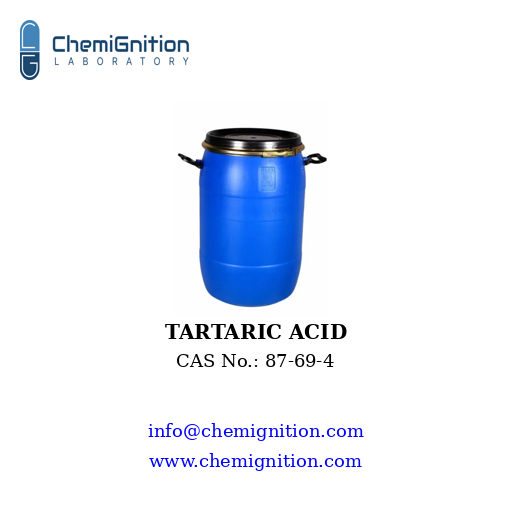
Packaging – The final product is packed in HDPE drums or bags with inner polythene liners to prevent contamination.
Storage – Stored in a cool, dry place away from moisture to maintain stability.
Tartaric Acid Applications
Pharmaceutical Industry
Excipient in Formulations
pH Regulator
Chelating Agent
Food & Beverage Industry
Acidulant
Bakery Products
Preservative
Industrial Applications
Tanning & Textile
Ceramics
Electroplating
Tartaric Acid Specifications
Tartaric Acid IP Specification
 Download Tartaric Acid IP Specification
| Sr. No. | Test | Specification |
|---|---|---|
| 1 | Description | White or almost white, crystalline powder or colourless crystals. |
| 2 | Solubility | Very soluble in water, freely soluble in ethanol (96 per cent). |
| 3 | Identification by Strong acid | It gives reaction of strongly acid |
| 4 | Identification by Tartrates | It gives reaction of Tartrates |
| 5 | Appearance of solution | Solution is clear and not more intensely coloured than reference solution. |
| 6 | Optical rotation | +12.0° to +12.8° |
| 7 | Oxalic acid | Not more than 360 ppm |
| 8 | Chlorides | Not more than 100 ppm |
| 9 | Sulphates | Not more than 150 ppm |
| 10 | Calcium | Not more than 200 ppm |
| 11 | Sulphated ash | Not more than 0.1% |
| 12 | Loss on drying | Not more than 0.2% |
| 13 | Assay (On dried basis) | Not less than 99.50 % and not more than 101.00% |
Tartaric Acid BP Specification
Download Tartaric Acid BP Specification
| Sr. No. | Test | Specification |
|---|---|---|
| 1 | Description | White or almost white, crystalline powder or colourless crystals. |
| 2 | Solubility | Very soluble in water, freely soluble in ethanol (96 per cent). |
| 3 | Identification by Strong acid | It gives reaction of strongly acid |
| 4 | Identification by Tartrates | It gives reaction of Tartrates |
| 5 | Appearance of solution | Solution is clear and not more intensely coloured than reference solution. |
| 6 | Optical rotation | +12.0° to +12.8° |
| 7 | Oxalic acid | Not more than 360 ppm |
| 8 | Chlorides | Not more than 100 ppm |
| 9 | Sulphates | Not more than 150 ppm |
| 10 | Calcium | Not more than 200 ppm |
| 11 | Sulphated ash | Not more than 0.1% |
| 12 | Loss on drying | Not more than 0.2% |
| 13 | Assay (On dried basis) | Not less than 99.50 % and not more than 101.00% |
Tartaric Acid USP Specification
Download Tartaric Acid USP Specification
| Sr. No. | Test | Specification |
|---|---|---|
| 1 | Description | White or almost white, crystalline powder or colourless crystals. |
| 2 | Solubility | Very soluble in water, freely soluble in ethanol (96 per cent). |
| 3 | Identification by IR | Complies with reference standard. |
| 4 | Inorganic impurities | Not more than 0.1% |
| 5 | Optical rotation | +12.0° to +13.0° |
| 6 | Oxalate | Passes the test |
| 7 | Loss on drying | Not more than 0.5% |
| 8 | Assay | Not less than 99.50 % and not more than 100.50% |
Tartaric Acid Packing and Storage condition
Packing:
- Packed in airtight HDPE drums or polyethylene-lined fiber drums to prevent moisture absorption.
- Available in 25 kg or 50 kg bags with inner double-layer polyethylene liners.
- Custom packaging options available as per customer requirements.
Storage Conditions:
- Store in a cool, dry, and well-ventilated area away from moisture.
- Keep away from direct sunlight, heat sources, and incompatible materials such as strong oxidizing agents.
- Recommended storage temperature: Below 30°C.
- Ensure the container is tightly closed when not in use to prevent contamination and degradation.
Why Choose Chemignition for
Tartaric Acid Supply?
Quality Assurance
Grade Compliance
Tartaric Acid is manufactured in adherence to stringent global pharmaceutical standards.
In-House Quality Control
Each batch undergoes rigorous testing for purity, stability, and efficacy.
Regulatory Approvals
Certified for export and compliant with international regulatory requirements.
Large-Scale Manufacturing and Export
Grade Compliance
Tartaric Acid is manufactured in adherence to stringent global pharmaceutical standards.
In-House Quality Control
Each batch undergoes rigorous testing for purity, stability, and efficacy.
Regulatory Approvals
Certified for export and compliant with international regulatory requirements.